
A STARTING POINT FOR YOUR NEXT TASK
GPT-6 Astra Gear Mechanism Simulation Prompt
A prompt for GPT-6 Astra to build a browser-based 3D simulation of a gear train with correct physical meshing and ratios.
改成你自己的任务。
- 补上你的材料、对象和使用场景。
- 说明要交付的文件、页面或文字,以及验收标准。
- 先在在线对话中梳理需求,再到桌面推进文件与工具执行。
中文参考
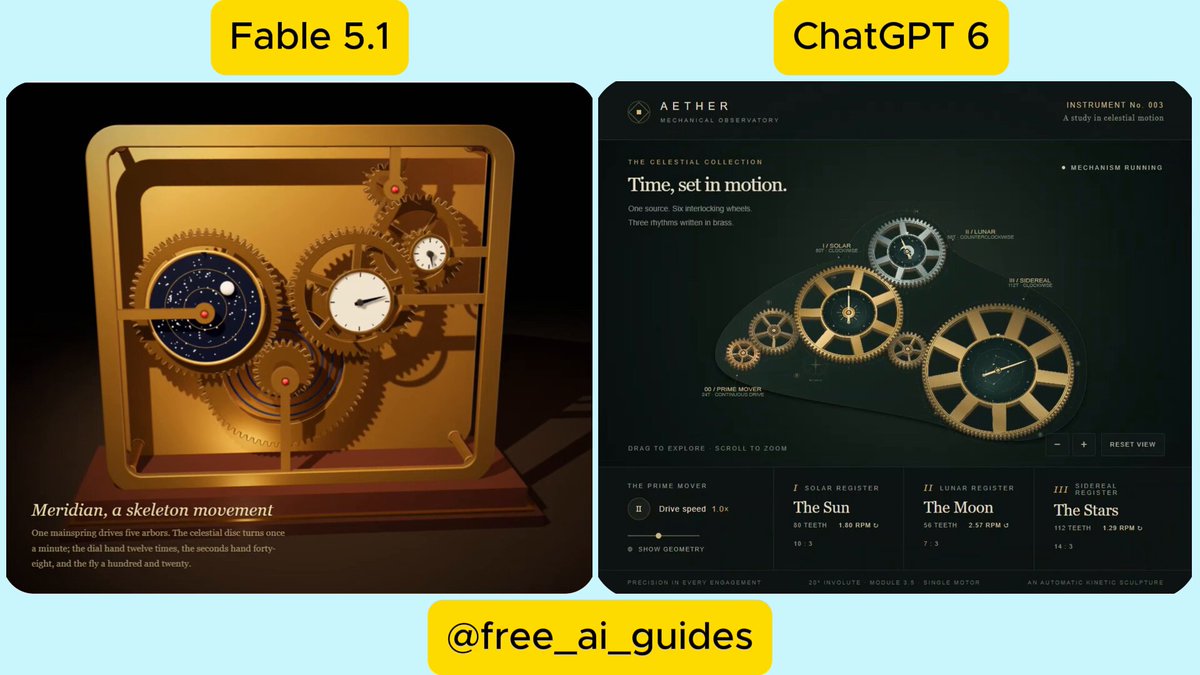
Fable 5.1 and GPT-6 Astra had to build a machine where a 60-tooth gear driving a 20-tooth gear turns it exactly three times faster. In a real mechanism, every gear has to mesh with its neighbor. The teeth need the same size and spacing or they won't fit together, and the speed of each gear comes straight from its tooth count. A gear with 60 teeth driving one with 20 turns it three times faster, no exceptions. That's why it's hard to simulate. You can't spin a few circles and call it clockwork. If the ratios are wrong, teeth pass through each other. If the alignment is off, the gears jam or drift apart, and every mistake shows the moment it starts turning. That's also what makes it a worthy test. Plenty of open builds hide sloppy logic behind nice visuals, and a gear train can't. The look of the mechanism is a free choice, but the meshing either works or it doesn't. The prompt asked for a train of gears driven by a single source, every gear meshing with its neighbors at the correct ratio, teeth aligned, and at least three visible outputs turning at different speeds. Both models got one attempt, no style direction, and no chance to fix anything afterward. You judge which one built the better mechanism.
原始提示词
Fable 5.1 and GPT-6 Astra had to build a machine where a 60-tooth gear driving a 20-tooth gear turns it exactly three times faster. In a real mechanism, every gear has to mesh with its neighbor. The teeth need the same size and spacing or they won't fit together, and the speed of each gear comes straight from its tooth count. A gear with 60 teeth driving one with 20 turns it three times faster, no exceptions. That's why it's hard to simulate. You can't spin a few circles and call it clockwork. If the ratios are wrong, teeth pass through each other. If the alignment is off, the gears jam or drift apart, and every mistake shows the moment it starts turning. That's also what makes it a worthy test. Plenty of open builds hide sloppy logic behind nice visuals, and a gear train can't. The look of the mechanism is a free choice, but the meshing either works or it doesn't. The prompt asked for a train of gears driven by a single source, every gear meshing with its neighbors at the correct ratio, teeth aligned, and at least three visible outputs turning at different speeds. Both models got one attempt, no style direction, and no chance to fix anything afterward. You judge which one built the better mechanism.
进入在线对话后,提示词会填入草稿,由你检查后发送。在线对话目前处理文本;网页、图片与 3D 制作需配合桌面端及相应工具。条目中的模型、技能和外部工具不代表当前账号已具备这些能力。